
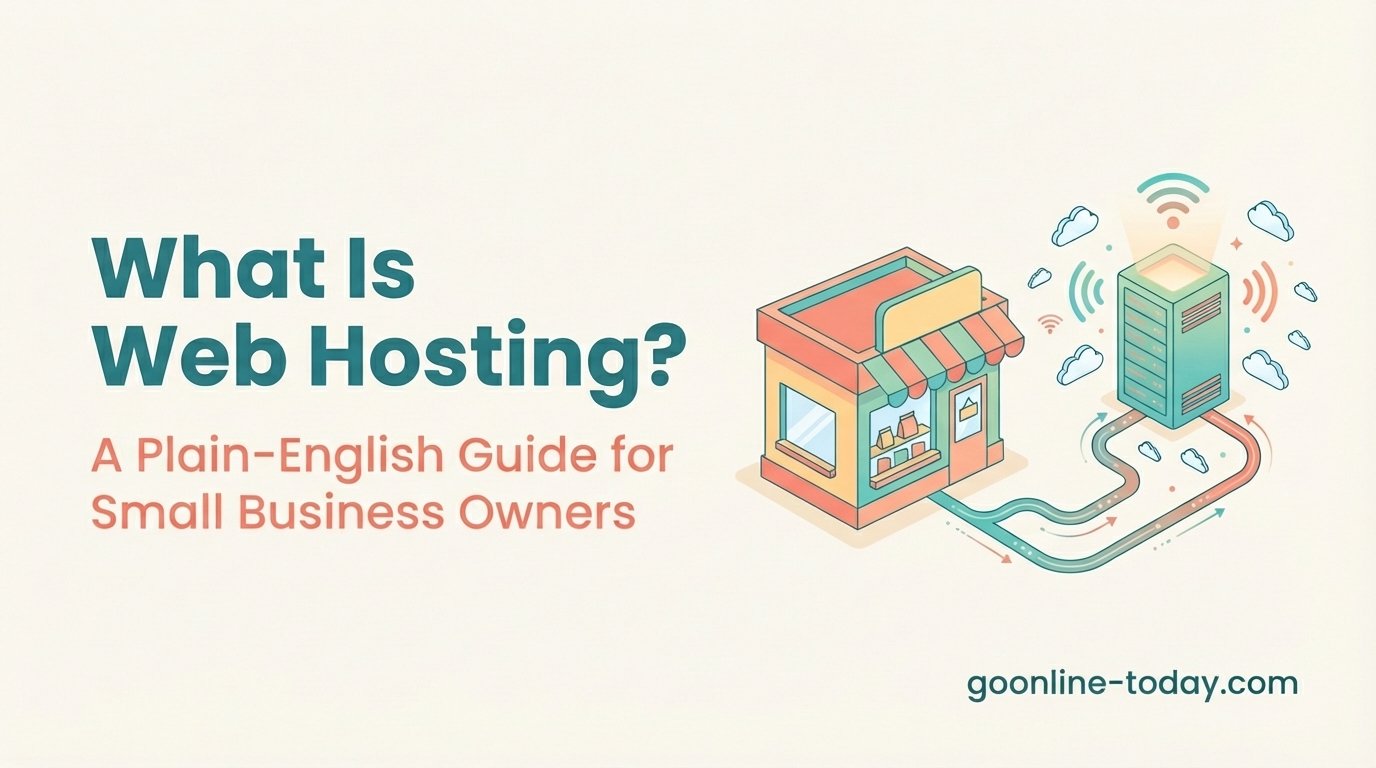
Every business website lives somewhere. Not on your laptop, not on a USB drive tucked in your desk drawer, but on a powerful computer that runs 24 hours a day, 7 days a week, connected to the internet at blistering speeds. That computer is called a server, and the service that gives your website a home on that server is called web hosting.
If that still sounds abstract, think of it this way. Your domain name is your business’s street address. Web hosting is the actual building sitting at that address. Without hosting, your customers type in your URL and get nothing. No storefront. No landing page. No contact form. Just a blank screen.
For small business owners taking their first steps online, understanding web hosting is not optional. It is the foundation everything else sits on.
FTC Disclosure: This post contains affiliate links. If you purchase through these links, we may earn a commission at no extra cost to you.
How Web Hosting Actually Works
When someone types your website address into their browser, a series of things happen almost instantly. Their browser reaches out to a Domain Name System (DNS) server, which translates your readable URL into a numerical IP address. That IP address points to the specific server where your website files are stored. The server then sends those files back to the visitor’s browser, which assembles them into the page they see.
The whole process takes a fraction of a second if your hosting is solid. It takes noticeably longer if it is not.
Think of it like a restaurant. Your domain name is the sign out front. Your hosting server is the kitchen. When a customer walks in and orders, the kitchen prepares the meal and sends it out. A fast, well-equipped kitchen delivers a great experience. A slow, overcrowded one loses customers before they even sit down.
Your web host is responsible for keeping that kitchen running. They maintain the server hardware, manage security, handle software updates, and make sure your site stays online. You pay them a monthly or annual fee for this service, and in return, you get a reliable place to park your website where the whole world can access it.
The Four Main Types of Web Hosting
Not every business needs the same kind of hosting, just like not every business needs the same size office. Here is how the four major types break down.
Shared Hosting
Shared hosting is where most small businesses start, and for good reason. With shared hosting, your website sits on a server alongside dozens or even hundreds of other websites. Everyone shares the same resources, including storage, processing power, and bandwidth.
The analogy here is a co-working space. Multiple businesses share the same building, the same Wi-Fi, the same break room. It keeps costs low for everyone, and for most small websites, the shared resources are more than sufficient.
Shared hosting typically costs between $2 and $10 per month, making it the most affordable option by a wide margin. For a business website with a few pages, a blog, and a contact form, shared hosting handles the job without breaking a sweat.
VPS Hosting
VPS stands for Virtual Private Server. It is still a shared physical machine, but the server is divided into virtual compartments, each with its own dedicated slice of resources. Think of it as upgrading from a co-working space to a private office within the same building.
VPS hosting usually runs between $20 and $100 per month. It is a good fit for businesses that have outgrown shared hosting, perhaps due to higher traffic or more resource-intensive applications. Most small businesses will not need VPS hosting on day one.
Dedicated Hosting
With dedicated hosting, you get an entire physical server to yourself. No sharing whatsoever. This is the equivalent of owning your own building. Maximum power, maximum control, maximum cost.
Prices for dedicated servers typically start around $80 per month and climb well into the hundreds. This is enterprise-level hosting for large-scale operations with heavy traffic demands. Unless a business is processing thousands of transactions daily, dedicated hosting is overkill.
Cloud Hosting
Cloud hosting spreads your website across a network of interconnected servers rather than relying on a single machine. If one server has an issue, another picks up the slack. It is built for flexibility and scalability, and the pricing model often adjusts based on the resources consumed.
Cloud hosting generally ranges from $10 to $200 per month depending on the configuration. It is increasingly popular with growing businesses that anticipate unpredictable traffic spikes.
Why Shared Hosting Is the Right Call for Most Small Businesses
Here is where I will be direct: if a small business is just getting online, shared hosting is almost certainly the right choice. There is a temptation to over-buy on hosting, the same way there is a temptation to lease a fancy office before signing a single client. Resist it.
A shared web hosting plan from a reputable provider will handle a business website, a blog, an email setup, and moderate traffic with no issues. The technology has improved dramatically over the past few years. Modern shared hosting platforms use solid-state drives, built-in caching, and content delivery networks that make sites load fast even on the most basic plans.
The cost difference matters too. Spending $3 to $7 per month on hosting versus $80 or more frees up budget for things that actually move the needle early on, like marketing, content creation, or professional design.
And the beauty of shared hosting is that upgrading is easy. If a business takes off and traffic outgrows the shared plan, every decent provider offers a smooth path to VPS or cloud hosting without starting from scratch.
What to Look for in a Web Hosting Provider
Not all hosting providers are created equal. Picking the cheapest plan on the first search result is a recipe for frustration. Here are the factors that actually matter when choosing a web hosting service.
Uptime Guarantee
Uptime refers to how often a hosting provider’s servers are actually online and accessible. Look for providers that guarantee at least 99.9% uptime. That may sound like a tiny margin, but the difference between 99.9% and 99% uptime is roughly 7 additional hours of downtime per month. For an online business, those hours translate directly to lost revenue and lost trust.
Speed and Performance
Page load speed affects everything from user experience to search engine rankings. Google has been clear that site speed is a ranking factor, and visitors expect pages to load in under three seconds. A hosting provider with modern hardware, SSD storage, and server-side caching will deliver noticeably faster performance than a budget host running aging equipment.
Customer Support
Technical issues happen. When they do, having access to 24/7 support through live chat, phone, or email is not a luxury. It is a necessity. Test a provider’s support before signing up. Send a pre-sales question and see how quickly and helpfully they respond. That small test tells you a lot about what to expect when something actually goes wrong.
Storage and Bandwidth
Storage determines how much content your website can hold, from images and videos to database entries. Bandwidth determines how much data can be transferred between your server and your visitors. For most small business sites, even the most basic shared hosting plans offer generous amounts of both. But it is worth confirming that a plan provides enough room to grow.
Scalability
A hosting provider should make it easy to upgrade as a business grows. Whether that means moving from shared hosting to VPS, or simply bumping up to a higher-tier shared plan, the transition should be seamless without forcing a site rebuild or migration hassle.
Security Features
At a minimum, any web hosting plan worth considering should include a free SSL certificate. SSL encrypts the data between a visitor’s browser and the server, and it is required for any business collecting customer information. Google also uses SSL as a ranking signal, so a site without it is disadvantaged in search results. Look for providers that also offer regular backups, malware scanning, and DDoS protection.
Two Hosting Providers Worth Considering
For small business owners ready to get started, two providers stand out for their combination of affordability, features, and ease of use.
Domain.com
Domain.com is best known as a domain registrar, but they also offer solid shared hosting plans that are well-suited for small businesses. Their entry-level hosting includes a free domain name when signing up for an annual plan, a free SSL certificate, and enough storage and bandwidth to comfortably run a business website. Plans start at competitive introductory pricing, and the interface is clean and beginner-friendly. For someone who wants to register a domain and set up hosting in one place with minimal fuss, Domain.com is a strong option.
Network Solutions
Network Solutions has been around for over 40 years, making them one of the longest-running names in the domain and hosting space. Their shared hosting Starter plan begins at around $2.99 per month on annual billing, which includes 15 GB of disk space, support for one website, and five email boxes. They also include a free domain name with annual hosting plans on their Essential tier and above, plus a free SSL certificate for the first year. For business owners who value a well-established provider with phone and chat support, Network Solutions delivers reliability backed by decades of experience.
Both providers offer free domain registration with their annual hosting plans, which saves roughly $10 to $20 in the first year. That is money better spent elsewhere.
Getting Started Does Not Have to Be Complicated
The web hosting industry has a habit of overcomplicating things. Jargon gets thrown around, features get stacked into comparison tables that nobody reads, and the sheer number of options creates paralysis. But the reality for most small business owners is straightforward.
Pick a reputable shared hosting provider. Choose an annual plan to lock in a lower rate and snag a free domain. Install WordPress or use the included website builder. Start building.
The hosting can always be upgraded later. The technology can always be swapped. But the decision to get online, to make a business findable, contactable, and credible to the millions of people who search the web every day, that is the decision that matters.
Web hosting is not glamorous. It is not the exciting part of building a business. But it is the part that makes everything else possible. And with shared hosting plans running just a few dollars per month, there is really no reason to wait.